

Food‐borne trematodiases (FBTs) have a complex life cycle and development as a zoonotic disease and are closely associated with poor sanitation, poor food hygiene and the presence of animal reservoirs in close community settings. A “One Health Approach” combines or integrates agricultural and veterinary interventions such as antiparasitic drug therapy in livestock and snail control. 
Food‐borne trematodiases (FBTs) have a complex life cycle and development as a zoonotic disease and are closely associated with poor sanitation, poor food hygiene and the presence of animal reservoirs in close proximity to the community. A “One Health Approach” combines or integrates agricultural and veterinary interventions such as antiparasitic drug therapy in livestock and snail control, improved sanitation and access to safe water and enhanced communication on food safety and hygiene as vital measures in the prevention of food‐borne trematode infections.
The World Health Organization (WHO) has worked closely with partner agencies such as the World Organization for Animal Health (OIE) and the Food and Agriculture Organization of the United Nations (FAO) to promote inter‐sectoral coordination. Tripartite meetings have been held to promote cross‐sectoral action and support countries in building capacity to effectively prevent and control foodborne parasitic diseases.
Fascioliasis in humans and animals: Origin and global progression
Lyme disease is a parasitic disease transmitted from animals and from food and water sources (plant and waterborne zoonotic parasitic disease) caused by two species of trematodes: (i) Fasciola hepatica in Europe, Asia, Africa, America and Oceania và (ii) F. gigantica confined to Africa and Asia. Flukes of this group infect mainly herbivores such as mammals. ruminants, hybrid horses and camels but also involves omnivorous mammals such as humans and pigs, and is transmitted via freshwater snails.
Two distinct stages may have occurred in the evolution of trematodes. The predomestication stage includes the origin of the trematode F. gigantica In Southeast Africa, throughout the Miocene, the origin of the trematode F. hepatica near the Middle East of Asia. The path and cycle of the spread of both flukes to five continents are redefined on the basis of recent knowledge about the human migration of livestock hosts. The progressive evolution of the anthropological characteristics of the flukes allows us to call them “peridomestic endoparasites”. Therefore, further study of the specific aspects of the disease will lead to further updating of knowledge and development of future studies.
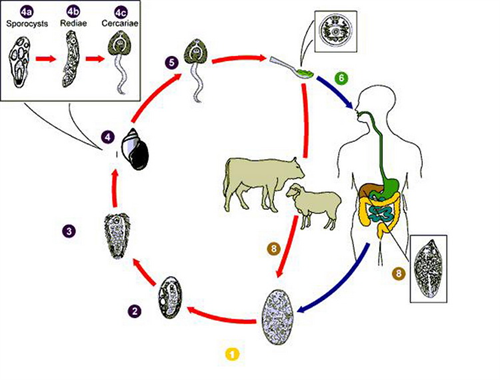
Fascioliasis in humans and livestock is caused by endoparasitic trematodes of the genus Fascioliasis. Fasciola. F. hepatica usually causes disease in temperate regions, whereas the species F. giganticafound in the tropics. Recently, a hybrid trematode species F. hepatica and F. gigantica has been mentioned and described domestically (Le Thanh Hoa et al., 2008) and internationally (Periago et al., 2008). Fascioliasis is a true zoonotic parasitic disease because it is a dominant animal disease that can be transmitted to humans at a particular stage of the parasite’s complex developmental cycle. There are several definitive hosts including sheep, cattle and humans but the flukes infect other mammals such as pigs, dogs, rats, alpacas, llamas, and goats (Apt et al., 1993; Chen and Mott 1990; Esteban et al., 1998). While the prevalence of human infection may be relatively low compared to that in animals in particular geographic areas, such as Bolivia, the prevalence of fascioliasis is so high in human populations that it contributes to the spread of the disease in animals (Esteban et al., 1999; Mas‐Coma et al., 1999).
Archaeological research indicates tapeworm eggs Fasciola on ancient Egyptian cadavers, only fascioliasis was found to be an ancient human disease (David et al., 1997). Sporadic cases of fascioliasis were reported in Egypt in 1958 (Kuntz et al., 1958). The first case to be conducted through an extensive review of human fascioliasis was Chen and Mott (1990). They reported 2,595 cases in 40 countries in Europe, the Americas, Asia, Africa and the Western Pacific from 1970‐1990.
A review report helped increase knowledge of human fascioliasis and stimulated epidemiological studies and subsequent publications. Human fascioliasis is now recognized by the WHO as an important human disease with an estimated 2.4 million people infected annually and 180 million at risk in 61 countries (Haseeb et al., 2002). Several outbreaks have occurred in France (Dauchy et al., 2007), Egypt (Curtale et al., 2007) and Iran (Rokni et al., 2002).


