

To date, there are at least 400 species of parasites that have been recorded that can infect and cause disease in humans, and the question is where do they come from and how to best and most effectively prevent disease? Recently, Konstans Wells (2018) pointed out that 49% of these parasites belong to the group of tapeworms, roundworms, trematodes and they are also present in wild animals as well as domestic animals, with a variety of species such as primates, rodents, cattle, kangaroos, etc.

Host diversity of parasites, including Toxocara spp.
To date, there are at least 400 species of parasites that have been recorded that can infect and cause disease in humans, and the question is where do they come from and how to best and most effectively prevent disease? Recently, Konstans Wells (2018) pointed out that 49% of these parasites belong to the group of tapeworms, roundworms, trematodes and they are also present in wild animals as well as domestic animals, with a variety of species such as primates, rodents, cattle, kangaroos, etc. In fact, more than 500 different wild animal species have been recorded to carry parasites similar to those in humans, and especially 45% of these parasites are also found in domestic animals such as dogs, cats, rabbits, pigs, sheep, black rats .
The food chain is involved in the transmission of parasitic diseases, many of which are transmitted by meat from domestic or wild animals contaminated with larvae, eggs or cysts, or by fecal contamination, soil, or accidental contamination of animals such as soil‐transmitted helminths. Transmission from animals to humans depends on close contact and human behavior and diet in “unsafe meat chains”.
Factors contributing to the increased prevalence of parasitic infections include climate change and extreme weather events. Globalization may be linked to the spread of parasitic diseases by increasing exposure to parasitic pathogens among humans, livestock and wild animals, including new, emerging and re‐emerging parasites, and thereby creating new human‐parasite interactions. Therefore, it is necessary to pay attention to treatment and prevention for both humans and livestock in the home and community environment to achieve an effective disease prevention model.
Practice good eating and environmental hygiene, eliminate pathogens
Distribution of diseases caused by Toxocara spp. geographically widespread with diverse routes of transmission including close contact with humans and domestic dogs and cats, transmission via unsanitary food and other “potentially risky” contacts. Therefore, enhanced health education will be essential to improve understanding of larval disease Toxocara spp. and prevention, treatment and control for dogs and cats. Veterinarians educate pet owners about roundworms in dogs and cats Toxocara spp. on how to reduce the risk of disease transmission from animals to humans.
Hygiene, preventing children from being infected with eggs Toxocara spp. from soil or animal feces, do not eat raw or undercooked food, as well as animal meat or organs. The interaction between humans, animals and the contaminated environment should be noted. According to the (One‐Health) view, a comprehensive approach is needed to effectively control larva migrans. Toxocara spp. in human. Infection control Toxocara spp. in definitive hosts to reduce the number of eggs shed in the environment. Deworming of dogs and cats, especially puppies under 12 weeks of age and kittens.
However, deworming treatment of pregnant dogs and cats is largely ineffective in preventing transplacental and breast‐feeding transmission. Reduce contact with contaminated soil, and wear gloves when gardening, handling plants, or handling manure. Pet feces should be collected and disposed of or buried because they may contain roundworm eggs. Implementing these measures in public areas such as parks and beaches is especially important to reduce transmission. Washing hands before eating and after playing with or caring for pets and after contact with dirt will reduce the risk of ingesting roundworm eggs.
One‐Health Model Approach in Larval Disease Control Toxocara spp.
Future directions should include ongoing research, including improved diagnostic tools, new targeted therapies, risk assessment, and international collaboration to invest in research and reduce the burden of disease. Emphasize the importance of understanding infection‐related T. canis impact on human health. If the One Health approach is implemented and effective disease prevention, diagnosis and treatment strategies are implemented, the burden of helminthiasis can be reduced. Toxocara spp., leading to improved health for both animals and humans.
The One Health model has been applied as a tool to address issues such as zoonotic diseases through a research team in Brazil, benefiting the National Health System, which samples soil, animals and humans simultaneously on different vulnerable populations as well as the animals around them, including animal hoarders, homeless and roaming animals, with appropriate punishment, etc. With this approach, animals are investigated simultaneously with their owners and the environment, providing a comprehensive picture of the role of new agents in different regions.
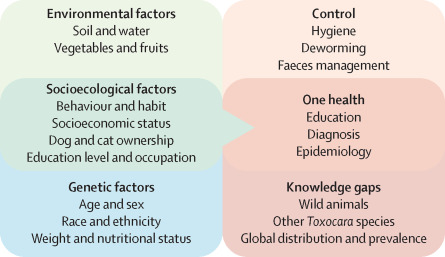
Factors that may be associated withToxocara spp. larval disease (blue)
‐ Environmental factors: Land and water, vegetables and fruits;
‐ Socio‐economic factors: Behavior and habits, socio‐economic status, dog and cat ownership, education level and occupation of owners and family members;
‐ Genetic factors: Age and sex, race and ethnicity, weight and nutritional status;
Disease prevention strategies and knowledge gaps (pink)
‐ Control through hygiene, regular deworming and manure management;
‐ Approaching the one‐Health model: Health education, diagnosis and epidemiological investigation;
‐ Knowledge gaps on: Wildlife, other Toxocara spp., incidence and global distribution of infection.
An “urban island‐effect hypothesis” has been proposed to describe an overlap of risk factors associated with human Toxocara spp. infection in classical island populations. The main cause of the “urban island effect” is the increasing displacement of vegetation and water by construction to meet the needs of growing populations in cities, and in this context, the urban heat island effect hypothesizes the potential for the spread of serious pathogens due to isolation and continuous exposure to “islands”, especially environmental, foodborne, vectorial and multi‐cyclic pathways facilitated by climate change.
In terms of terminology, the urban heat island effect has been applied in three other situations: (i) Foster’s rule (Foster’s rule) also known as the urban heat island effect, where animal populations on isolated islands can change in size; (ii) Urban heat island (Urban heat island) to design an appropriate spatial‐temporal temperature distribution in urban areas; (iii) Nut island effect (Nut island effect) as a management principle for a less efficient isolated group. Previous studies have shown the widespread dissemination of parasitic pathogens in Fernando de Noronha ‐ a stopover on the top of an island for tourists in Brazil with human‐animal‐environment overlap. In such studies, high seroprevalence of T. gondii protozoa was detected in 172/341 (50.4%) islanders, related to high seroprevalence in the cat population and environmental contamination with T. gondii.
Based on prevalence and public health impact, toxocariasis is currently an under‐appreciated zoonotic disease in both developed and developing countries. Transmission of toxocariasis is associated with unowned pets, dogs and cats, leading to widespread shedding of eggs through feces into the environment. One of the important risk factors for infection and development of toxocariasis in humans is cohabitation with kittens and puppies.
For a long time, the prevention strategy for parasitic infections has been to routinely use drugs or deworming to reduce the burden in the short term. Long‐term protective immunity can be achieved after vaccination, but vaccines are still under research. Therefore, the foundation for understanding the development of advanced vaccines that are effective against this zoonotic disease is needed. Furthermore, experimental studies have focused on the development of vaccines against toxocariasis. In particular, special attention has been paid to the outstanding epidemiological studies as well as the importance of dogs in Toxocara spp .
The One Health concept is defined as a multidisciplinary collaborative effort that involves health professionals, veterinarians, and researchers working together locally, regionally, nationally, and globally to achieve optimal human, animal, and environmental health. From this perspective, Toxocara spp . is a research paradigm in which classical and modern knowledge in the human and veterinary fields must work together to achieve a comprehensive understanding with a common goal of integrating effective diagnosis, treatment, and prevention.
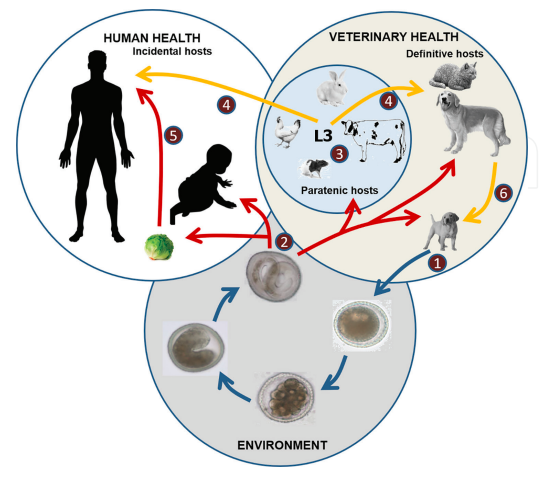
The life cycle of Toxocara spp. involves definitive hosts (dogs and cats), transient hosts (some mammals and birds) and accidental hosts (humans). Puppies are the main source of immature eggs released into the environment (1). Under optimal conditions of humidity and temperature, the third‐stage larvae develop within the eggs and are the primary infective stage for all hosts (2). Transient hosts or accidental hosts that ingest larval eggs maintain the larval body in the tissues (3) which can infect transient hosts. Human infection occurs mainly through ingestion of larval eggs or consumption of raw meat or organs of animals (chicken, pig, cow) containing infective larvae (4). Ingestion of larval eggs can also result from consumption of contaminated vegetables (5). Larvae present in the definitive host are transmitted to puppies via the placenta (dogs) and via suckling (dogs and cats) (6). The green arrows indicate the development dynamics of eggs in the environment, the red arrows indicate transmission from larval eggs, and the yellow arrows indicate transmission from body larvae.
Research on vaccine to prevent Toxocara spp. larvae
Dumar Alexander Jaramillo-Hernández Protective response mediated by immunization with recombinant proteins in a murine model of toxocariasis and canine infection by Toxocara canis.
The development of a formulation that can be used as a vaccine would help the definitive control of the infection. Preclinical studies selected two recombinant T. canis proteins (rTcVcan and rTcCad) which significantly protected mice against larval migration. In the present work, these proteins plus three adjuvants (Alhydrogel®, PAM3CSK4®, and Quil‐A®) were used to immunize mice against toxocariasis; blood samples were collected three times to measure IgG (total, IgG1, IgG2a), IgA, and IgE via indirect ELISA. Cytokines (IL‐5, TNF‐α, and IL‐10) were measured in splenocytes supernatant, and T. canis larvae were quantified in tissues. The best protein + adjuvant pair found (rTVcan + QuialA®) was then used to immunize T. canis‐free puppies (n = 18) that were experimentally infected with T. canis and T. canis naturally‐infected puppies (n = 6). Immunoglobulin (IgA, IgE, IgG, IgG1, and IgG2a), parasite load (eggs in feces), number of expelled adults and eggs extracted from the female uterus, and their fertility percentages were analyzed.
In mice, it was observed a highly significant reduction (73%) of tissue larvae, a mixed cytokine profile (Th1/Th2), and anti‐T. canis antibody titers (IgG, IgG1, IgG2a) using rTVcan + QuialA® mix. In canines, rTVcan + QuialA® promoted reduction in the parasite eggs in feces (95%) and eggs reduction obtained from the uteri of pharmacologically expelled adult females (58.38%). In our knowledge this is the first canine clinical trial of a vaccine with T. canis recombinant proteins. The formulation used has been shown to efficiently stimulate the production of antibodies against infection by T. canis.
In the canine, a significant reduction in the number of eggs expelled by the experimental animals that received the formulation prophylactically was evidenced. Future tests should be developed to evaluate the duration of the protective effect and analyze other immune pathways that could be stimulated by the formulation used.
Luis Fabián Salazar Garcés Immunogenicity and protection induced by recombinant Toxocara canis proteins in a murine model of toxocariasis. Eight potential vaccine candidate T. canis recombinant proteins were identified by in silico (rTcGPRs, rTcCad, rTcVcan, rTcCyst) and larval proteomics (rTES26, rTES32, rMUC‐3 and rCTL‐4) analyses.
Immunogenicity and protection against infectious challenge for seven of these antigens were determined in a murine model of toxocariasis. C57BL/6 female mice were immunized with each of or combinations of recombinant antigens prior to challenge with 500 T. canis embryonated eggs.
Levels of specific antibodies (IgG, IgG1, IgG2a and IgE) in sera and cytokines (IL‐5, INF‐ɣ and IL‐10) produced by antigens‐stimulated splenocytes, were measured. Presence of specific antibodies to the molecules was measured in sera of T. canis‐seropositive dogs and humans.
All seven molecules were immunogenic in immunized mice; all stimulated significantly elevated levels of specific IgG, IgG1 or IgG2a and six were associated with elevated levels of specific IgE; all induced elevated production of IFN‐ ɣ and IL‐10 by splenocytes, but only the in silico‐identified membrane‐associated recombinants (rTcCad, rTcVcan, and rTcCyst) induced significantly increased IL‐5 production. Vaccination with two of the latter (rTcCad and rTcVcan) reduced larval loads in the T. canis challenged mice by 54.3% and 53.9% (P < 0.0001), respectively, compared to unimmunized controls. All seven recombinants were recognized by T. canis‐seropositive dog and human sera.
Besides, Dumar A. Jaramillo‐Hernández and partners (2023) base on the prevalence and public health impact of Toxocara spp. have not been adequately assessed in developed and developing countries. Transmission of Toxocara spp. involves free‐roaming, unowned pets that shed eggs in their feces, and one of the major risk factors for infection and development of Toxocara spp. is cohabitation with puppies and kittens. For a long time, the strategy for prevention of this disease has been to routinely use antiparasitic drugs to reduce the burden in the shortest possible time. Long‐term immune protection can be achieved with vaccines, but there are currently no widely available vaccines and they are only in the research phase. Therefore, the above data provide a basis for understanding the latest developments in the development of effective vaccines for this disease.
Because of the high prevalence and burden of disease caused by spp. larvae and their widespread distribution worldwide, a group of Brazilian and Canadian scientists have recently focused on research on vaccines in developing and developed countries. Currently, the main prevention strategy is to use anti‐nematodes and periodic deworming to reduce the burden in a short period of time, so how to protect the population by vaccination is more important and sustainable. The importance of parasitic diseases in humans and animals globally and the emergence and increasing severity of drug resistance in animals, so the need for research on vaccines to prevent diseases, reduce the risk of exposure from animals to humans, in which the development of vaccines for dogs will play a fundamental role in good disease management for both pets and indirectly for humans.
Because the prevalence and burden of Toxocara spp. larvae are high and widely distributed worldwide, a group of Brazilian and Canadian scientists have recently focused on researching vaccines to prevent the disease in developing and developed countries. Currently, the main prevention strategy is to use anti‐nematodes and periodic deworming to reduce the burden in a short time, so how to protect the population by immunization through vaccination is more important and sustainable. The importance of parasitic diseases in humans and animals globally and the emergence and increasing severity of drug resistance in animals, so the need for research on vaccines to prevent the disease, reduce the risk of exposure from animals to humans, in which the development of vaccines to prevent the disease in dogs will play a fundamental role in good disease management for both pets and indirectly for humans. While waiting for the birth and widespread application of a safe and effective vaccine, regular deworming for dogs and cats is one of the most important links in disease prevention measures. For puppies and kittens, the first dose of deworming should be given as soon as they are 2‐3 weeks old (because dogs and kittens can be infected with worms from their mothers before or after birth, or through milk and puppies often excrete many eggs in the environment), deworming 3 times with an interval of 2 weeks and then repeated every 6 months. Use preventive anti‐worm drugs periodically, including puppies and pregnant bitches to limit the spread of disease;
Disease prevention includes environmental sanitation, especially areas at risk of dog and cat feces being spread, indoor areas and children’s play areas every day. Clean up and immediately remove pet feces to prevent the spread of pathogens into the environment;
Wash your hands after touching, holding, petting or playing with dogs or cats or after contact with places at risk of infection. Develop and encourage good personal hygiene habits and behaviors, wash hands regularly with soap before eating, ensure cooked food and water, regularly clean children’s play areas;
Communicate health education, raise awareness of personal and community hygiene, protect the environment from being contaminated with dog and cat feces. In particular, mobilize the community to change behavior, improve health, avoid related factors or risks of infection.


