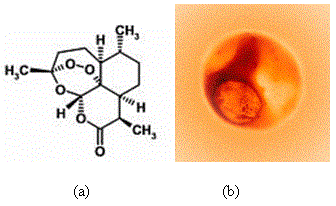
Nhân loại có 3 kẻ thù quan trọng đó là sốt, đói nghèo và chiến tranh. Trong đó, sốt vẫn được coi là nguy hiểm nhất (“Humanityhasbutthreegreatenemies, Fever,famineandwar:ofthesebyfarthe greatest,byfarthemostterribleisfever ‐William Osler, 1896). Sốt rét vẫn là vấn đề y tế công cộng nghiêm trọng với tỷ lệ mắc và tử vong tiếp tục giữ vị trí cao trong danh sách các bệnh truyền nhiễm. Sốt rét ác tính (SRAT) là vấn đề cấp cứu y khoa bởi diễn tiến bệnh nhanh với các biến chứng nghiêm trọng, đe dọa tử vong cao cho nhiều bệnh nhân.
SRAT thường gặp do P.falciparum, nhưng cũng có thể gặp do P. vivax, hay P. knowlesi, số ca tử vong vẫn còn cao mặc dù đã được chăm sóc tích cực và điều trị thuốc đặc hiệu, song nhiều vấn đề chi phối vào vấn đề này. Diễn tiến nhanh do thường thương tổn đa cơ quan và đa biến chứng nặng cộng thêm sinh lý bệnh không kiểm soát thấu đáo nên dễ dẫn đến tử vong. Việc cảnh giác, theo dõi và phát hiện các dấu hiệu dự báo sớm sẽ giúp hạn chế SRAT và tử vong do sốt rét (TVSR) là rất cần thiết. Hiên nay, SRAT chưa thiết lập mô hình trên súc vật thực nghiệm để chứng minh thỏa đáng cho cơ chế SRAT ở người và khoa học vẫn schưa hiểu tường tận về cơ chế SRAT nên chỉ đưa ra các giả thuyết, song dựa trên y học bằng chứng, trong đó tựu trung các giả thuyết sau:
•Giả thuyết đóng quánh, tắc bùn (Sludging view);
•Giả thuyết tăng tính thấm (Permeaability);
•Giả thuyết cơ học;
•Giả thuyết miễn dịch;
•Một số yếu tố góp phần
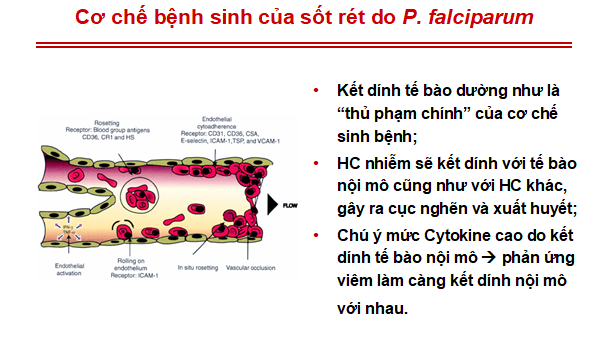
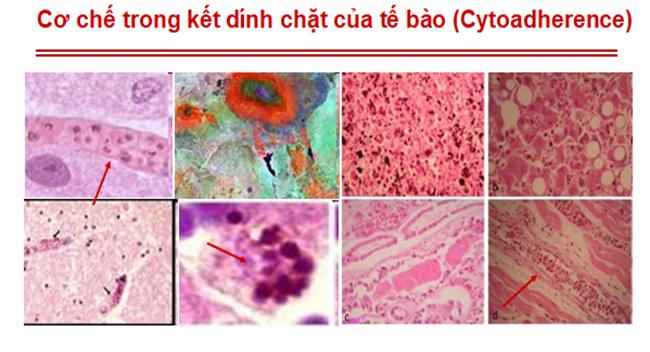
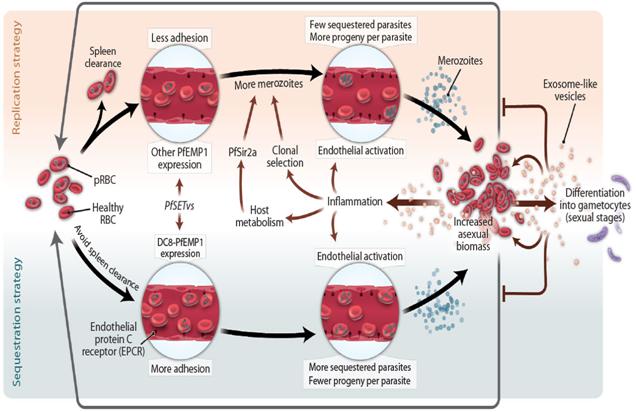
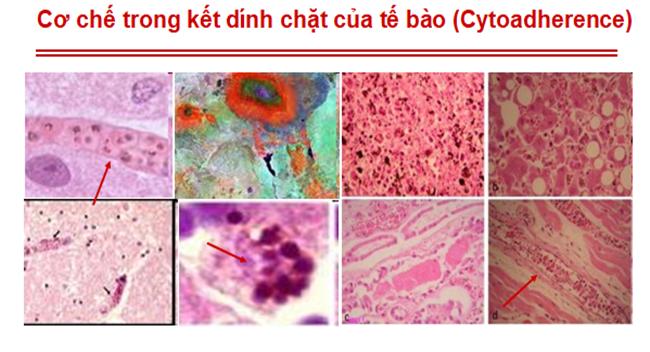
Trong đó, giả thuyết đóng quánh, bùn tắc dựa trên các bằng chứng dựa trên sau bệnh phẩm sau mổ tử thi bị SR do P.falciparum: các vi huyết quản chứa đầy hồng cầu (HC) bị ký sinh, trong khi máu ngoại vi chứa rất ít KSTSR. Thể KSTSR thường gặp là các tư dưỡng già và phân liệt. Các HC nhiễm dính vào nhau, di chuyển trong lòng mạch khó khăn dẫn đến chậm dòng chảy nên sẽ tắc lại. Khi có sự ẩn cư và tắc nghẽn thì sẽ dẫn đến hậu quả nghẽn mạch, thiếu oxy nuôi mô và cơ quan, tiết độc tố và tạo vòng lẩn quẩn cho SRAT.
 |
Sự ẩn cư trong lòng mạch và kết dính tế bào đã được nghiên cứu phân tích trên các mô hình động vật, trong đó mô hình thứ 1 cho thấy sự ẩn cư (bít tắc vi mạch) là “thủ phạm” chính. Trong nhiễm P. falciparum chỉ có giai đoạn sớm (thể nhẫn) tìm thấy trong máu ngoại vi và thể tư dưỡng và thể phân liệt đóng bít tắc các mạch sau mao mạch (post‐capilary venules) do dính vào tế bào nội mô. Bào tương HC được lấy bởi hiện tượng endocytosis, quá trình thực bào xảy ra với Hb trong khoang không bào, tiêu hóa một lượng lớn heme và heme gây độc cho KSTSR và được trung hòa bởi polymer hóa thành hạt pigment hoặc hemozoine. Chloroquin (CQ) tích tụ trong không baog tiêu hóa (giống với các lysosomes không bào), CQ can thiệp vào qúa trình polymer hóa và khử oxy của heme. Giả thuyết tăng tính thấm mao mạch qua sau mổ tử thi cho thấy phù não trong sốt rét ác tính thể não (SRATTN). Tăng tính thấm làm huyết tương thoát ra ngoài, nhu mô não phù nề, máu cô đặc, độ quánh của máu tăng, lưu lượng chảy giảm à do vậy có thời gian chỉ định dùng sterocorticoides và dung dịch manitol để chống phù não (nay đã chống chỉ định).
 |
Phù gai thị ít gặp hơn rất nhiều, phù não không phải là đặc điểm riêng cho SRATTN. Nếu tủy sống không bị nghẽn, phù não làm tăng áp lực nội sọ, sẽ làm tăng áp lực não tủy vùng lưng, nhưng thực tế áp lực này không tăng. Tại sao như vậy? Có nên loại trừ giả thuyết? Trên mô hình súc vật thực nghiệm khỉ Rhesus nhiễm P. knowlesi có sự tăng tính thấm hàng rào mạch máu não, có thể bị khống chế nhanh sau khi dùng hydrocortisone.
Mô hình khỉ Rhesus nhiễm P. knowlesi không giống như người nhiễm P. falciparum về mặt lâm sàng và sinh lý bệnh. Hôn mê không phải là triệu chứng nổi bật của khỉ, sự ẩn cư và khu biệt không rõ ràng khi quan sát trên mẫu bệnh phẩm. CQcó tác dụng chống viêm tốt, nhưng không cải thiện tri giác trênSRATTN. Nghiên cứu thử nghiệm lâm sàng so sánh dexamethasone liều cao và liều thường dùng không làm thay đổi tỷ lệ tử vong và thời gian hôn mê kéo dài hơn khi dùng corticoides.
 |
Giả thuyết cơ học trong SRAT cho biết chính là sự tắc nghẽn vi tuần hoàn do tràn ngập KSTSR ẩn cư (tư dưỡng và phân liệt) dẫn đến thiếu oxy tại chỗ. Hai nguyên nhân / cơ chế dẫn đến tắc nghẽn:
‐Giảm tính biến dạng:
•HC bình thường rất “flexible” khi luồn lách và lưu thông trong lòng vi huyết quản, nếu HC không còn “Flexible”, tắc nghẽn sẽ xảy ra;
•KSTSR càng trưởng thành thì song song HC càng giảm tính biến dạng trong lòng vi huyết quản à tắc cụm
‐Kết dính tế bào (rất chặt):
•Tế bào nội mô và HC nhiễm dính chặt vào nhau;
•HC nhiễm và HC không nhiễm cũng dính nhau à tạo hoa thị
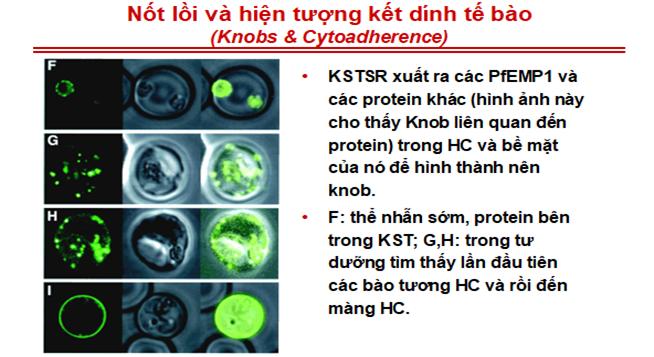
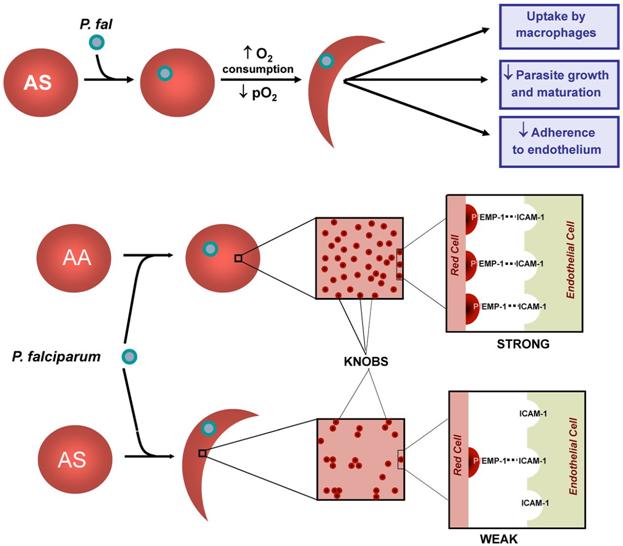
•Dòng KSTSR có knobs (núm lồi) dễ dính, protein màng hồng cầu PfEMP‐1
Kết dính tế bào và tạo hoa hồng liên quan với sự xuất hiện các “knobs” trên bề mặt của hồng cầu nhiễm, các HC nhiễm có dòng không chồi (knob‐less strain) không gây SRATTN. Các knobs trên KSTSR xuất phát từ các protein.
 |
Giả thuyết liên quan đến miễn dịch gồm có SRAT hay xảy ra ở người vào vùng sốt rét, chưa có miễn dịch hoặc bán miễn dịch (semi‐immunity). KSTSR gây đáp ứng MD thể dịch và MD qua trung gian tế bào, hoạt hóa bổ thể. Đáp ứng tăng động của hệ TKTƯ với phức hợp kháng nguyên loài KSTSR P. falciparum (rất đa dạng). Viêm mạch (trong viêm cầu thận tăng sinh màng và hoại tử ống thận cấp) do phức hợp miễn dịch nghĩ đến trong SR do P. falciparum và P. malariae. Rất tiếc, corticosteroides lại không cải thiện các triệu chứng trong SRATTN và hoại tử ống thận cũng như viêm cầu thận, mà còn ngược lại. Cơ chế dựa trên giả thuyết này chưa thật sự thuyết phục hoặc thỏa đáng. SRATTN được đặc trưng bởi xuất huyết đa điểm trong não. Nồng độ TNF‐a và INFg (2 loại cytokine quan trọng) trong huyết thanh và mô vượt mức cho phép liên quan đến SRAT.
 |
Một số nhà nghiên cứu tin rằng phản ứng viêm này là nguyên nhân chính cho cơ chế bệnh sinh (nhớ rằng đáp ứng miễn dịch quá mức chống lại màm bệnh mạn tính không thể làm rõ nguyên nhân gây SRAT). Một số giả thuyết & yếu tố khác liên quan đến SRAT gồm:
•Nhiễm độc với SRAT:
‐SRAT tử vong do sốc, HA hạ, mô không cung đủ oxy, rối loạn tim mạch;
‐SR thể giá lạnh: giảm bạch cầu, suy thận, phù phổi, hạ HA, hạ thân nhiệt như nhiễm endotoxxine;
•Vai trò NO:
‐Cho rằng NO quá nhiều sinh ra SRATTN, NO gây nhiễm độc cơ hô hấp, giảm hoạt động à SHH. Chất NO còn hủy hoại protein, acid nucleotide, oxy hóa lipid, tổn thương tế bào;
‐Không đồng thuận: NO cao ở SRT > SRAT; NO lại là chát bảo vệvật chủ trong SRAT ?
•Vai trò Cytokines:
‐Cơn bão Cytokines;
‐Cytokines kích thích men tổng hợp NO từ L‐arginine thành NO

Hình 1
1.Muentener P, Schlagenhauf P, Steffen R. Imported malaria (1985‐95): trends and perspectives. Bull World Health Organ. 1999;77:560‐566. [PMC free article][PubMed]
2.Sachs J, Malaney P. The economic and social burden of malaria. Nature. 2002;415:680‐685. doi: 10.1038/415680a. [PubMed][Cross Ref]
3.Kain KC, Keystone JS. Malaria in travelers. Epidemiology, disease, and prevention. Infect Dis Clin North Am. 1998;12:267‐284. [PubMed]
4.Kain KC, Harrington MA, Tennyson S, Keystone JS. Imported malaria: prospective analysis of problems in diagnosis and management. Clin Infect Dis. 1998;27:142‐149. [PubMed]
5.Garcia LS. Malaria and babesiosis. In: Garcia LS, editor. Diagnostic Medical Parasitology.
6.
7.
8.Murphy GS, Oldfield EC., III Falciparum malaria. Infect Dis Clin North Am. 1996;10:747‐775. [PubMed]
9.Genton B, D’Acremont V. Clinical features of malaria in returning travelers and migrants. In: Schlagenhauf P, editor. Travelers’ malaria.
10.Svenson JE, MacLean JD, Gyorkos TW, Keystone J. Imported malaria. Clinical presentation and examination of symptomatic travelers. Arch Intern Med. 1995;155:861‐868. doi: 10.1001/archinte.155.8.861. [PubMed][Cross Ref]
11.World Health Organization Severe and complicated malaria. Trans R Soc Trop Med Hyg. 1990;84(suppl 2):S1‐S65.
12.World Health Organization Severe falciparum malaria. Trans R Soc Trop Med Hyg. 2000;94(suppl 1):S1‐S90. [PubMed]
13.Bruneel F, Hocqueloux L, Alberti C, Wolff M, Chevret S, Bedos JP, Durand R, Le Bras J, Regnier B, Vachon F. The clinical spectrum of severe imported falciparum malaria in the ICU: Report of 188 cases in adults. Am J Respir Crit Care Med. 2003;167:684‐689. doi: 10.1164/rccm.200206‐631OC. [PubMed][Cross Ref]

Hình 2
14.Blumberg L, Lee RP, Lipman J, Beards S. Predictors of mortality in severe malaria: a two year experience in a non‐endemic area. Anaesth Intensive Care. 1996;24:217‐223. [PubMed]
15.Schwartz E, Sadetzki S, Murad H, Raveh D. Age as a risk factor for severe Plasmodium falciparum malaria in nonimmune patients. Clin Infect Dis. 2001;33:1774‐1777. doi: 10.1086/322522. [PubMed][Cross Ref]
16.D’Acremont V, Landry P, Mueller I, Pecoud A, Genton B. Clinical and laboratory predictors of imported malaria in an outpatient setting: an aid to medical decision making in returning travelers with fever. Am J Trop Med Hyg. 2002;66:481‐486. [PubMed]
17.Doherty JF, Grant AD, Bryceson AD. Fever as the presenting complaint of travellers returning from the tropics. QJM. 1995;88:277‐281. [PubMed]
18.Moody AH, Chiodini PL. Methods for the detection of blood parasites. Clin Lab Haematol. 2000;22:189‐201. doi: 10.1046/j.1365‐2257.2000.00318.x. [PubMed][Cross Ref]
19.Torres JR. Malaria and babesiosis. In: Baddour LM, Gorbach SL, editor. Therapy of Infectious Diseases.
20.Nguyen PH, Day N, Pram TD,
21.Lee SH, Kara UA, Koay E, Lee MA, Lam S, Teo D. New strategies for the diagnosis and screening of malaria. Int J Hematol. 2002;76(suppl 1):291‐293. [PubMed]
22.Moody A. Rapid diagnostic tests for malaria parasites. Clin Microbiol Rev. 2002;15:66‐78. doi: 10.1128/CMR.15.1.66‐78.2002. [PMC free article][PubMed][Cross Ref]
23.Hanscheid T, Grobusch MP. How useful is PCR in the diagnosis of malaria? Trends Parasitol. 2002;18:395‐398. doi: 10.1016/S1471‐4922(02)02348‐6. [PubMed][Cross Ref]
Hình 3
24.Warrell DA, Looareesuwan S, Warrell MJ, Kasemsarn P, Intaraprasert R, Bunnag D, Harinasuta T. Dexamethasone proves deleterious in cerebral malaria. A double‐blind trial in 100 comatose patients. N Engl J Med. 1982;306:313‐319. [PubMed]
25.
26.Gachot B, Wolff M, Nissack G, Veber B, Vachon F. Acute lung injury complicating imported Plasmodium falciparum malaria. Chest. 1995;108:746‐749. [PubMed]
27.Bernard GR, Artigas A, Brigham KL, Carlet J, Falke K, Hudson L, Lamy M, LeGall JR, Morris A, Spragg R. Report of the American‐European consensus conference on ARDS: definitions, mechanisms, relevant outcomes and clinical trial coordination. The Consensus Committee. Intensive Care Med. 1994;20:225‐232. [PubMed]
28.Prakash J, Gupta A, Kumar O, Rout SB, Malhotra V, Srivastava PK. Acute renal failure in falciparum malaria: increasing prevalence in some areas of
29.Mehta KS, Halankar AR, Makwana PD, Torane PP, Satija PS, Shah VB. Severe acute renal failure in malaria. J Postgrad Med. 2001;47:24‐26. [PubMed]
30.Watt G, Shanks GD, Phintuyothin P. Prognostic significance of rises in parasitaemia during treatment of falciparum malaria. Trans R Soc Trop Med Hyg. 1992;86:359‐360. [PubMed]
31.Anonymous Canadian recommendations for the prevention and treatment of malaria among international travellers. Committee to Advise on Tropical Medicine and Travel (CATMAT), Laboratory for Disease Control. Can Commun Dis Rep. 2000;26(suppl 2):1‐42. [PubMed]
32.Anonymous Availability and use of parenteral quinidine gluconate for severe or complicated malaria. MMWR Morb Mortal Wkly Rep. 2000;49:1138‐1140. [PubMed]
33.
34.Bonington A, Davidson RN, Winstanley PA, Pasvol G. Fatal quinine cardiotoxicity in the treatment of falciparum malaria. Trans R Soc Trop Med Hyg. 1996;90:305‐307. [PubMed]
35.Sukontason K, Karbwang J, Rimchala W, Tin T, Na‐Bangchang K, Banmairuroi V, Bunnag D. Plasma quinine concentrations in falciparum malaria with acute renal failure. Trop Med Int Health. 1996;1:236‐242. [PubMed]

Hình 4
36.Bethell DB, Phuong PT, Phuong CX, Nosten F, Waller D,
37.Pittler MH, Ernst E. Artemether for severe malaria: a meta‐analysis of randomized clinical trials. Clin Infect Dis. 1999;28:597‐601. [PubMed]
38.Tran TH, Day NP, Nguyen HP, Nguyen TH, Tran TH, Pham PL, Dinh XS, Ly VC, Ha V, Waller D, Peto TE, White NJ. A controlled trial of artemether or quinine in Vietnamese adults with severe falciparum malaria. N Engl J Med. 1996;335:76‐83. doi: 10.1056/NEJM199607113350202. [PubMed][Cross Ref]
39.Murphy S, English M, Waruiru C, Mwangi I, Amukoye E, Crawley J, Newton C, Winstanley P, Peshu N, Marsh K. An open randomized trial of artemether versus quinine in the treatment of cerebral malaria in African children. Trans R Soc Trop Med Hyg. 1996;90:298‐301. [PubMed]
40.Hatz CF. Clinical treatment of malaria in returned travelers. In: Schlagenhauf P, editor. Travelers’ Malaria.
41.Blum PG, Stephens D. Severe falciparum malaria in five soldiers from
42.Anonymous Ventilation with lower tidal volumes as compared with traditional tidal volumes for acute lung injury and the acute respiratory distress syndrome. The Acute Respiratory Distress Syndrome Network. N Engl J Med. 2000;342:1301‐1308. doi: 10.1056/NEJM200005043421801. [PubMed][Cross Ref]
43.Anzueto A, Baughman RP, Guntupalli KK, Weg JG, Wiedemann HP, Raventos AA, Lemaire F, Long W, Zaccardelli DS, Pattishall EN. Aerosolized surfactant in adults with sepsis‐induced acute respiratory distress syndrome. Exosurf Acute Respiratory Distress Syndrome Sepsis Study Group. N Engl J Med. 1996;334:1417‐1421. doi: 10.1056/NEJM199605303342201. [PubMed][Cross Ref]
44.Dellinger RP, Zimmerman JL, Taylor RW, Straube RC, Hauser DL, Criner GJ, Davis K, Jr, Hyers TM, Papadakos P. Effects of inhaled nitric oxide in patients with acute respiratory distress syndrome: results of a randomized phase II trial. Inhaled Nitric Oxide in ARDS Study Group. Crit Care Med. 1998;26:15‐23. [PubMed]
Hình 5
45.Wilairatana P, Westerlund EK, Aursudkij B, Vannaphan S, Krudsood S, Viriyavejakul P, Chokejindachai W, Treeprasertsuk S, Srisuriya P, Gordeuk VR, Brittenham GM, Neild G, Looareesuwan S. Treatment of malarial acute renal failure by hemodialysis. Am J Trop Med Hyg. 1999;60:233‐237. [PubMed]
46.Kellum JA, Angus DC, Johnson JP, Leblanc M, Griffin M, Ramakrishnan N, Linde‐Zwirble WT. Continuous versus intermittent renal replacement therapy: a meta‐analysis. Intensive Care Med. 2002;28:29‐37. doi: 10.1007/s00134‐001‐1159‐4. [PubMed][Cross Ref]
47.Day NP, Phu NH, Mai NT, Chau TT, Loc PP, Chuong LV, Sinh DX, Holloway P, Hien TT, White NJ. The pathophysiologic and prognostic significance of acidosis in severe adult malaria. Crit Care Med. 2000;28:1833‐1840. [PubMed]
48.Panosian CB. Exchange blood transfusion in severe falciparum malaria ‐ the debate goes on. Clin Infect Dis. 1998;26:853‐854. [PubMed]
49.Riddle MS, Jackson JL, Sanders JW, Blazes DL. Exchange transfusion as an adjunct therapy in severe Plasmodium falciparum malaria: a meta‐analysis. Clin Infect Dis. 2002;34:1192‐1198. doi: 10.1086/339810. [PubMed][Cross Ref]
50.
51.Kwiatkowski D, Molyneux ME, Stephens S, Curtis N, Klein N, Pointaire P, Smit M, Allan R, Brewster DR, Grau GE. Anti‐TNF therapy inhibits fever in cerebral malaria. Q J Med. 1993;86:91‐98. [PubMed]
52.Warrell DA. Management of severe malaria. Parassitologia. 1999;41:287‐294. [PubMed]
Wassmer SC, Taylor TE, Rathod PK, Mishra SK, Mohanty S, Arevalo‐Herrera M, Duraisingh MT, Smith JD.
Am J Trop Med Hyg. 2015 Sep;93(3 Suppl):42‐56. doi: 10.4269/ajtmh.14‐0841. Epub 2015 Aug 10. Review.
PMID: 26259939 Free PMC Article Similar articles Select item 172150452.
54.UK malaria treatment guidelines.
Lalloo DG, Shingadia D, Pasvol G, Chiodini PL, Whitty CJ, Beeching NJ, Hill DR, Warrell DA, Bannister BA; HPA Advisory Committee on Malaria Prevention in UK Travellers.
J Infect. 2007 Feb;54(2):111‐21. Epub 2007 Jan 9.
PMID: 17215045 Similar articles Select item 267145063.
Mitra S, Abhilash K, Arora S, Miraclin A.
J Vector Borne Dis. 2015 Dec;52(4):281‐6.
PMID: 26714506 Free Article Similar articles Select item 185639614.

Hình 6
Genton B, D’Acremont V, Rare L, Baea K, Reeder JC, Alpers MP, Müller I.
PLoS Med. 2008 Jun 17;5(6):e127. doi: 10.1371/journal.pmed.0050127.
PMID: 18563961 Free PMC Article Similar articles Select item 166876675.
Sattabongkot J, Yimamnuaychoke N, Leelaudomlipi S, Rasameesoraj M, Jenwithisuk R, Coleman RE, Udomsangpetch R, Cui L, Brewer TG.
Am J Trop Med Hyg. 2006 May;74(5):708‐15.
PMID: 16687667 Similar articles Select item 224720136.
Manning L, Rosanas‐Urgell A, Laman M, Edoni H,
Malar J. 2012 Apr 3;11:107. doi: 10.1186/1475‐2875‐11‐107.
PMID: 22472013 Free PMC Article Similar articles Select item 253259237.
59.Plasmodium falciparum, but not P. vivax, can induce erythrocytic apoptosis.
Totino PR, Magalhães Ad, Alves EB, Costa MR, de Lacerda MV, Daniel‐Ribeiro CT, Ferreira‐da‐Cruz Mde F.
Parasit Vectors. 2014 Oct 18;7:484. doi: 10.1186/s13071‐014‐0484‐8.
PMID: 25325923 Free PMC Article Similar articles Select item 275337978.
60.Retinopathy of vivax malaria in adults and its relation with severity parameters.
Kochar A, Kalra P, Sb V, Ukirade V, Chahar A, Kochar DK, Kochar SK.
Pathog Glob Health. 2016 Jun‐Jul;110(4‐5):185‐93. doi: 10.1080/20477724.2016.1213948. Epub 2016 Aug 17.
PMID: 27533797 Free PMC Article Similar articles Select item 270756679.
Hình 7
Seyoum D, Kifle YG, Rondeau V, Yewhalaw D, Duchateau L, Rosas‐Aguirre A, Speybroeck N.
Malar J. 2016 Apr 14;15:208. doi: 10.1186/s12936‐016‐1253‐2.
PMID: 27075667 Free PMC Article Similar articles Select item 1908938810.
Cui L, Trongnipatt N, Sattabongkot J, Udomsangpetch R.
Methods Mol Biol. 2009;470:263‐73. doi: 10.1007/978‐1‐59745‐204‐5_18.
PMID: 19089388 Similar articles Select item 2363472811.
Abdallah TM,
Malar J. 2013 May 1;12:148. doi: 10.1186/1475‐2875‐12‐148.
PMID: 23634728 Free PMC Article Similar articles Select item 2675181112.
64.Multiplicity of Infection and Disease Severity in Plasmodium vivax.
Pacheco MA, Lopez‐Perez M, Vallejo AF, Herrera S, Arévalo‐Herrera M, Escalante AA.
PLoS Negl Trop Dis. 2016 Jan 11;10(1):e0004355. doi: 10.1371/journal.pntd.0004355. eCollection 2016 Jan.
PMID: 26751811 Free PMC Article Similar articles Select item 1934921013.
65.The pathophysiology of vivax malaria.
Trends Parasitol. 2009 May;25(5):220‐7. doi: 10.1016/j.pt.2009.02.003. Epub 2009 Apr 6. Review.
PMID: 19349210 Similar articles Select item 2450266414.
Mekonnen SK, Aseffa A, Medhin G, Berhe N, Velavan TP.
Malar J. 2014 Feb 6;13:48. doi: 10.1186/1475‐2875‐13‐48.
PMID: 24502664Free PMC ArticleSimilar articles Select item 2434155515.
Bi Y, Yu W, Hu W, Lin H, Guo Y, Zhou XN, Tong S.
Parasit Vectors. 2013 Dec 17;6:357. doi: 10.1186/1756‐3305‐6‐357.
PMID: 24341555Free PMC ArticleSimilar articles Select item 849345416.
Carlson J.
Scand J Infect Dis Suppl. 1993;86:1‐79.
PMID: 8493454 Similar articles Select item 2525321317.
Kochar DK, Das A, Kochar A, Middha S, Acharya J, Tanwar GS, Pakalapati D, Subudhi AK, Boopathi PA, Garg S, Kochar SK.
J Vector Borne Dis. 2014 Sep;51(3):200‐10.
PMID: 25253213 Free Article Similar articles Select item 2318189618.
Arango EM, Samuel R, Agudelo OM, Carmona‐Fonseca J, Maestre A, Yanow SK.
Malar J. 2012 Nov 26;11:392. doi: 10.1186/1475‐2875‐11‐392.
PMID: 23181896 Free PMC Article Similar articles Select item 2588487519.
Lo E, Yewhalaw D, Zhong D, Zemene E, Degefa T, Tushune K, Ha M, Lee MC, James AA, Yan G.
Malar J. 2015 Feb 19;14:84. doi: 10.1186/s12936‐015‐0596‐4.
PMID: 25884875 Free PMC Article Similar articles Select item 2082250620.
Hình 8
Harris I, Sharrock WW, Bain LM, Gray KA, Bobogare A, Boaz L, Lilley K, Krause D, Vallely A, Johnson ML, Gatton ML, Shanks GD, Cheng Q.
Malar J. 2010 Sep 7;9:254. doi: 10.1186/1475‐2875‐9‐254.
PMID: 20822506 Free PMC Article Similar articles
Rosanas‐Urgell A, Senn N, Rarau P, Aponte JJ, Reeder JC, Siba PM, Michon P, Mueller I.
Int J Parasitol. 2012 Nov;42(12):1107‐13. doi: 10.1016/j.ijpara.2012.10.001. Epub 2012 Oct 17.
PMID: 23085147 Similar articles Select item 2319948822.
74.Plasmodium vivax: clinical spectrum, risk factors and pathogenesis.
Adv Parasitol. 2012;80:151‐201. doi: 10.1016/B978‐0‐12‐397900‐1.00003‐7. Review.
PMID: 23199488 Similar articles Select item 2253373323.
Zoghi S, Mehrizi AA, Raeisi A, Haghdoost AA, Turki H, Safari R, Kahanali AA, Zakeri S.
Malar J. 2012 Apr 25;11:126. doi: 10.1186/1475‐2875‐11‐126.
PMID: 22533733 Free PMC Article Similar articles Select item 2380582224.
Woyessa A, Deressa W, Ali A, Lindtjørn B.
Malar J. 2013 Jun 27;12:218. doi: 10.1186/1475‐2875‐12‐218.
PMID: 23805822 Free PMC Article Similar articles Select item 2363721825.
Karimi A, Navidbakhsh M, Motevalli Haghi A, Faghihi S.
Proc Inst Mech Eng H. 2013 Apr;227(4):428‐37. doi: 10.1177/0954411912474611. Epub 2013 Jan 23.
PMID: 23637218 Similar articles Select item 2188175926.
78.Biomarkers for susceptibility to infection and disease severity in human malaria.
Andrade BB, Barral‐Netto M.
Mem Inst Oswaldo Cruz. 2011 Aug;106 Suppl 1:70‐8. Review.
PMID: 21881759 Free ArticleSimilar articles Select item 2449985227.
79.Assessing the association of severe malaria infection and ABO blood groups in northwestern Ethiopia.
Tadesse H, Tadesse K.
J Vector Borne Dis. 2013 Dec;50(4):292‐6.
PMID: 24499852 Free Article Similar articles Select item 2510735528.
Saravu K, Rishikesh K, Kamath A,
Malar J. 2014 Aug 8;13:304. doi: 10.1186/1475‐2875‐13‐304.
PMID: 25107355 Free PMC Article Similar articles Select item 1993060929.
Gillet P, van Dijk DP, Bottieau E, Cnops L, Van Esbroeck M, Jacobs J.
Malar J. 2009 Nov 22;8:262. doi: 10.1186/1475‐2875‐8‐262.
PMID: 19930609 Free PMC Article Similar articles Select item 2705613230.
Karl S, Laman M, Moore BR, Benjamin JM, Salib M, Lorry L, Maripal S, Siba P, Robinson LJ, Mueller I, Davis TM.
Acta Trop. 2016 Aug;160:1‐8. doi: 10.1016/j.actatropica.2016.04.002. Epub 2016 Apr 4.
PMID: 27056132 Similar articles Select item 1040537731.

Hình 9
Tjitra E, Suprianto S, Dyer M, Currie BJ, Anstey NM.
J Clin Microbiol. 1999 Aug;37(8):2412‐7.
PMID: 10405377 Free PMC Article Similar articles Select item 2624240532.
Golassa L, Baliraine FN, Enweji N, Erko B, Swedberg G, Aseffa A.
BMC Infect Dis. 2015 Aug 5;15:310. doi: 10.1186/s12879‐015‐1070‐1.
PMID: 26242405 Free PMC Article Similar articles Select item 766772933.
Somboon P, Suwonkerd W, Lines JD.
Southeast Asian J Trop Med Public Health. 1994 Dec;25(4):766‐70.
PMID: 7667729 Similar articles Select item 2532607934.
Tajebe A, Magoma G, Aemero M, Kimani F.
Malar J. 2014 Oct 18;13:411. doi: 10.1186/1475‐2875‐13‐411.
PMID: 25326079 Free PMC Article Similar articles Select item 1652278035.

Hình 10
Kassa D, Petros B, Mesele T, Hailu E, Wolday D.
Clin Vaccine Immunol. 2006 Mar;13(3):376‐9.
PMID: 16522780 Free PMC Article Similar articles Select item 2589036836.
Fransisca L, Kusnanto JH, Satoto TB, Sebayang B, Supriyanto, Andriyan E, Bangs MJ.
Malar J. 2015 Mar 5;14:103. doi: 10.1186/s12936‐015‐0615‐5.
PMID: 25890368 Free PMC Article Similar articles Select item 2618693637.
Niang M, Thiam LG, Sow A, Loucoubar C, Bob NS, Diop F, Diouf B, Niass O, Mansourou A, Varela ML, Perraut R, Sall AA, Toure‐Balde A.
Malar J. 2015 Jul 19;14:281. doi: 10.1186/s12936‐015‐0808‐y.
PMID: 26186936 Free PMC Article Similar articles Select item 808226438.
90.[Purification and isolation of different stages of Plasmodium vivax, P. falciparum and P. berghei].
Zhongguo Ji Sheng Chong Xue Yu Ji Sheng Chong Bing Za Zhi. 1993;11(4):262‐6. Chinese.
PMID: 8082264 Similar articles Select item 1052356739.
91.Comparison of the OptiMAL test with PCR for diagnosis of malaria in immigrants.
Iqbal J, Sher A, Hira PR, Al‐Owaish R.
J Clin Microbiol. 1999 Nov;37(11):3644‐6.
PMID: 10523567 Free PMC Article Similar articles Select item 2360838540.
92.Plasmodium vivax cerebral malaria complicated with venous sinus thrombosis in Colombia.
Pinzón MA, Pineda JC, Rosso F, Shinchi M, Bonilla‐Abadía F.
Asian Pac J Trop Med. 2013 May 13;6(5):413‐5. doi: 10.1016/S1995‐7645(13)60050‐4.
PMID: 23608385 Free Article Similar articles
Nielsen MA, Staalsoe T, Kurtzhals JA, Goka BQ, Dodoo D, Alifrangis M, Theander TG, Akanmori BD, Hviid L.
J Immunol. 2002 Apr 1;168(7):3444‐50.
PMID: 11907103 Free Article Similar articles Select item 1238993742.
Coleman RE, Maneechai N, Rachaphaew N, Kumpitak C, Miller RS, Soyseng V, Thimasarn K, Sattabongkot J.
Am J Trop Med Hyg. 2002 Aug;67(2):141‐4.
PMID: 12389937 Similar articles Select item 2326166543.
Prosper O, Martcheva M.
Math Biosci. 2013 Mar;242(1):33‐50. doi: 10.1016/j.mbs.2012.11.015. Epub 2012 Dec 19.
PMID: 23261665 Similar articles Select item 2176258744.
96.Plasmodium vivax Malaria among military personnel, French Guiana, 1998‐2008.
Queyriaux B, Texier G, Ollivier L, Galoisy‐Guibal L, Michel R, Meynard JB, Decam C, Verret C, Pommier de Santi V, Spiegel A, Boutin JP, Migliani R, Deparis X.
Emerg Infect Dis. 2011 Jul;17(7):1280‐2. doi: 10.3201/eid1707.100009.
PMID: 21762587 Free PMC Article Similar articles Select item 2804037445.
97.The Rheopathobiology of Plasmodium vivax and Other Important Primate Malaria Parasites.
Russell BM, Cooke BM.
Trends Parasitol. 2017 Apr;33(4):321‐334. doi: 10.1016/j.pt.2016.11.009. Epub 2016 Dec 29. Review.
PMID: 28040374 Similar articles Select item 195186646.
98.The number of sporozoites produced by individual malaria oocysts.
Am J Trop Med Hyg. 1991 Nov;45(5):574‐7.
PMID: 1951866 Similar articles Select item 2599691647.
Koepfli C, Robinson LJ, Rarau P, Salib M, Sambale N, Wampfler R, Betuela I, Nuitragool W, Barry AE, Siba P, Felger I, Mueller I.
PLoS one. 2015 May 21;10(5):e0126747. doi: 10.1371/journal.pone.0126747. eCollection 2015.
PMID: 25996916 Free PMC Article Similar articles Select item 2181025648.
Mula P, Fernández‐Martínez A, de Lucio A, Ramos JM, Reyes F, González V, Benito A, Berzosa P.
Malar J. 2011 Aug 2;10:214. doi: 10.1186/1475‐2875‐10‐214.
PMID: 21810256 Free PMC ArticleSimilar articles Select item 2426164649.
Gray KA, Dowd S, Bain L, Bobogare A, Wini L, Shanks GD, Cheng Q.
Malar J. 2013 Nov 22;12:429. doi: 10.1186/1475‐2875‐12‐429.
PMID: 24261646 Free PMC Article Similar articles Select item 2037092050.
Kinzer MH, Chand K, Basri H, Lederman ER, Susanti AI, Elyazar I, Taleo G, Rogers WO, Bangs MJ, Maguire JD.
Malar J. 2010 Apr 6;9:89. doi: 10.1186/1475‐2875‐9‐89.
PMID: 20370920 Free PMC Article Similar articles Select item 2221621251.
Manning L, Laman M, Law I, Bona C, Aipit S, Teine D, Warrell J, Rosanas‐Urgell A, Lin E, Kiniboro B, Vince J, Hwaiwhanje I, Karunajeewa H, Michon P, Siba P, Mueller I, Davis TM.
PLoS one. 2011;6(12):e29203. doi: 10.1371/journal.pone.0029203. Epub 2011 Dec 22.
PMID: 22216212 Free PMC Article Similar articles Select item 2097960152.
Hình 11
Ashton RA, Kefyalew T, Tesfaye G, Counihan H, Yadeta D, Cundill B, Reithinger R, Kolaczinski JH.
Malar J. 2010 Oct 27;9:297. doi: 10.1186/1475‐2875‐9‐297.
PMID: 20979601 Free PMC Article Similar articles Select item 2061792353.
105.On the cytoadhesion of Plasmodium vivax-infected erythrocytes.
Carvalho BO, Lopes SC, Nogueira PA, Orlandi PP, Bargieri DY, Blanco YC, Mamoni R, Leite JA, Rodrigues MM, Soares IS, Oliveira TR, Wunderlich G, Lacerda MV, del Portillo HA, Araújo MO, Russell B, Suwanarusk R, Snounou G, Rénia L, Costa FT.
J Infect Dis. 2010 Aug 15;202(4):638‐47. doi: 10.1086/654815.
PMID: 20617923 Similar articles Select item 2061899054.
Maltha J, Gillet P, Cnops L, van den Ende J, van Esbroeck M, Jacobs J.
Malar J. 2010 Jul 10;9:198. doi: 10.1186/1475‐2875‐9‐198.
PMID: 20618990 Free PMC Article Similar articles Select item 175268655.
107.Transfusion associated malaria in endemic areas.
Choudhury N, Jolly JG, Ganguly NK, Mahajan RC, Dube ML.
Indian Pediatr. 1991 May;28(5):554‐7. No abstract available.
PMID: 1752686 Similar articles Select item 2418831356.
108.Severe Plasmodium vivax malaria in Pakistan.
Zubairi AB, Nizami S, Raza A, Mehraj V, Rasheed AF, Ghanchi NK, Khaled ZN, Beg MA.
Emerg Infect Dis. 2013 Nov;19(11):1851‐4. doi: 10.3201/eid1911.130495.
PMID: 24188313 Free PMC Article Similar articles Select item 2071362757.