

In order to evaluate the skills of national microscopists in detecting and diagnosing malaria in blood samples using a microscope, the World Health Organization (WHO) Representative Office for Viet Nam organized the External Competency Assessment of Malaria Microscopists (ECAMM) course in Quy Nhon city from 05‐09 September 2022.

In order to evaluate the skills of national microscopists in detecting and diagnosing malaria in blood samples using a microscope, the World Health Organization (WHO) Representative Office for Viet Nam organized the External Competency Assessment of Malaria Microscopists (ECAMM) course in Quy Nhon city from 05‐09 September 2022.
Participants to the ECAMM course came from the National Institute of Malariology, Parasitology and Entomology (NIMPE), Institute of Malariology, Parasitology and Entomology Quy Nhon (IMPE‐QN), and Institute of Malariology, Parasitology and Entomology Ho Chi Minh (IMPE‐HCM). Twelve participants were assessed by Mrs. Bina Srivastava, external facilitator designated by WHO. The opening ceremony of the ECAMM was highly honored by the presence of Assoc.Prof. Dr. Ho Van Hoang ‐ Director of IMPE‐QN, Dr. Nguyen Quy Anh, PhD. ‐ Vice‐Head of Epidemiology Department of NIMPE, and Mrs. Pham Lien Dai, Officer of WHO Viet Nam.
Speaking at the opening ceremony of the course, Assoc.Prof.Dr. Ho Van Hoang ‐ Director of IMPE‐QN emphasized the importance of competency assessment for microscopists in malaria diagnose. The Director said that early diagnosis and rapid treatment is a key component of malaria control. According to global standards, the detection of malaria parasites through microscopy remains one of the best methods for malaria diagnosis and is considered by WHO as the gold standard in determining malaria parasites. The microscopists take an extremely important part in the malaria program, from diagnosing malaria to training, inspecting, and monitoring the operation of microscopy sites across the country. Therefore, it is necessary to have a high standard assessment program for malaria microscopists in order to ensure the quality of malaria diagnosis.


During the 5‐day interactive course, the participants were assessed for their proficiency in parasite detection, species identification, and parasite density calculation through a standard set of 56 validated slides from the WHO Malaria Slide Bank. These slides were of 4 malaria parasite species, includingPlasmodium falciparum, Plasmodium vivax, Plasmodium malariae, Plasmodium ovale and some mixed‐species infections.
Theoretical review sessions also helped microscopists to consolidate knowledge about all aspects of malaria microscopy. The refresher modules included overview of malaria: global malaria situation and epidemiology of malaria; microscope use and care; malaria parasite species (P.f, P.v, P.o, P.m and P.k) microscopically; malaria parasite counting; blood elements and artefacts; quality assurance in malaria laboratory diagnosis, and training‐revision options.
Before each test slide examination (9‐10 slides), the facilitator reviewed the slides being examined the previous day, found out the key factors for correct identification of the species and parasite density, and drew lessons for next assessment slides. During the course, participants were assigned a level from 1 to 4, based on the competence demonstrated in the assessments.

Table 1. WHO Competence Levels
| Competence Level | Parasite Detection | Species Identification | Parasite Counting (within 25% of the true count) |
| Level 1 | ³ 90% | ³ 90% | ³ 50% |
| Level 2 | ³ 80% | ³ 80% | ³ 40% |
| Level 3 | ³ 70% | ³ 70% | ³ 30% |
| Level 4 | < 70% | < 70% | < 30% |
The assessments resulted in ten microscopists certified level 1, one certified level 2 and one certified level 3. Only those who achieved level 1 or 2 were awarded with the certificate that is valid for the next three (3) years. This level is a pre‐requisite for microscopy diagnosis in antimalarial drug efficacy studies or clinical trials.
The ECAMM was performed in an honest and ethical environment. Through this course, the microscopists’ competence have been improved in terms of the accuracy, precision, sensitivity and specificity in malaria diagnosis. Improved quality of laboratory‐confirmed diagnosis of malaria will retain the confidence of clinicians in laboratory results, leading to improved case management and appropriate use of antimalarial drugs, contributing to the malaria elimination agenda in Viet Nam by 2030.

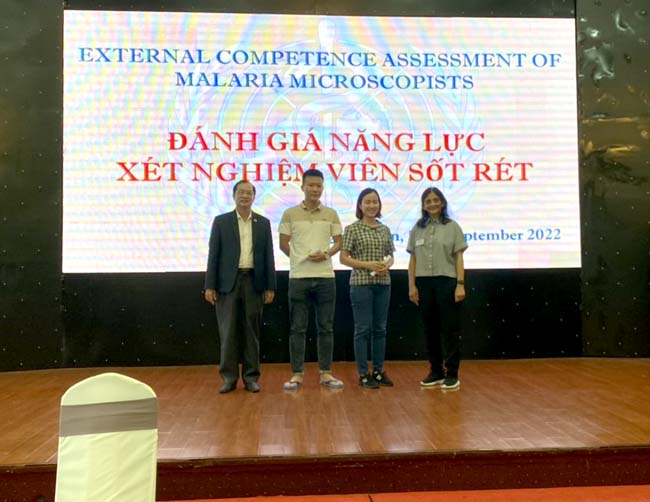
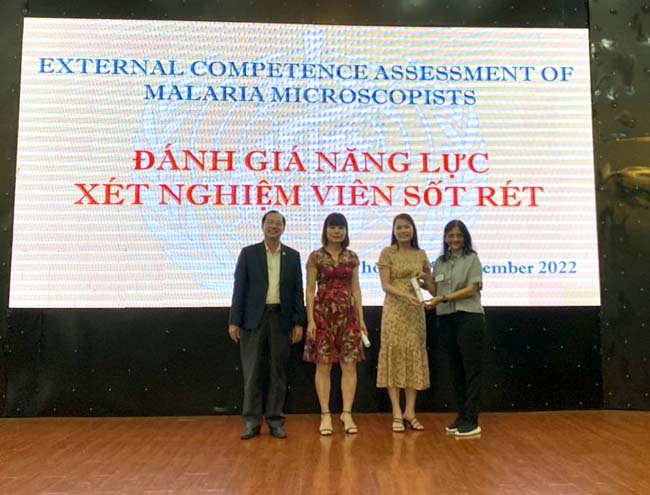
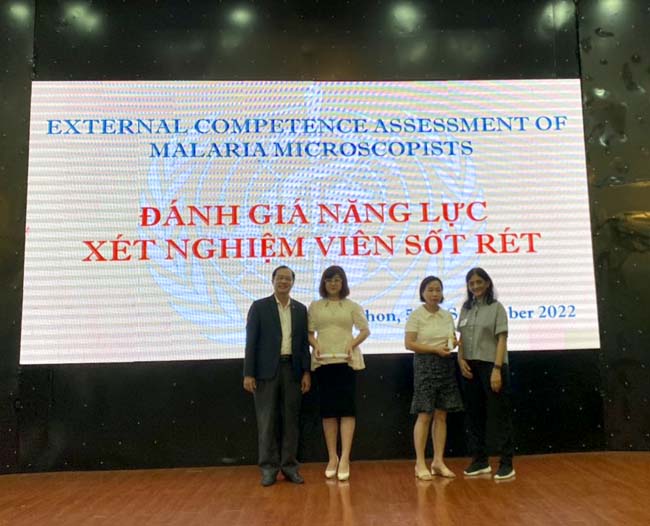
Some images at the closing ceremony of the ECAMM course:


By An Khang


