

In the dry season, the air humidity is low, so groups of pathogenic bacteria grow and spread very quickly, especially when there are humid southerly winds accompanied by erratic sunshine of extreme weather, skin diseases or disorders increase. At that time, the number of people with skin disorders is higher than in other seasons.

I. INTRODUCTION TO SOME COMMON SKIN DISORDERS
In the dry season, the air humidity is low, so groups of pathogenic bacteria grow and spread very quickly, especially when there are wet southerly winds accompanied by erratic sunshine of extreme weather, skin diseases or disorders increase. At that time, the number of people with skin disorders is higher than in other seasons. Many people do not understand the cause and do not know how to treat it properly, making the disease more serious and persistent. In particular, when the weather changes, the body sweats less, which is a favorable condition for skin diseases to increase such as dermatitis, itching, allergic skin diseases, eczema, psoriasis to develop and flare up in acute episodes of a chronic disease. Notably, eczema often appears in the ankle area, lower leg, dry itchy skin, rough, wrinkled, red, with blisters or pustules when infected.
The skin is the largest organ, accounting for about 16% of the total body weight. The skin is a barrier that separates the endothelium from the environment and keeps the body in a certain shape. On cold days, when the humidity in the air is low, human skin often becomes dry and dehydrated. Skin care in winter is very necessary, but not everyone does it correctly. In Europe, in winter, skin problems such as winter rash often appear. In Vietnam, the dry season occurs from May to October. This is the time when the skin is often dry, flaky, and red. Before learning about ways to care for dry skin in the dry season, you should recognize the types of skin diseases.
Low air humidity reduces skin moisture, causing skin dehydration, increasing the stratum corneum, causing many people’s skin to become itchy, tight, dry, even flaky and cracked. Some diseases that we often encounter in clinical practice when the weather is dry:

1. Staphylococcal‐streptococcal dermatitis
During the hot, humid and dry season, many people are susceptible to staphylococcal dermatitis. The disease often manifests as red patches of skin and blisters scattered all over the body, but is characterized by scaly, itchy scalp or shins. Patients always feel cold due to heat loss through the skin. These patients must go to a health facility for examination and prescription of topical medications combined with systemic antibiotic and anti‐inflammatory treatment.
2. Atopic dermatitis
In the dry season, atopic dermatitis often progresses chronically, can heal for a while, then relapse. The skin areas that are prone to dryness and damage due to frequent scratching are usually the armpits, the breast area, the groin, the elbows, and the back of the knees. Treatment is not easy because the lesions are infected, the use of drugs often has side effects. Atopic dermatitis is a type of eczema, is hereditary, or is caused by the skin losing its protective moisture barrier. Common lesions are dry skin on the hands, feet, face, redness and scaling, especially the joints of the hands and feet. In the dry season, atopic dermatitis lesions can develop and spread, causing horizontal and vertical cracks in the skin, even oozing fluid and blood.
Atopic dermatitis is a chronic and recurrent skin disease. The disease often appears on the face, wrists, and areas with folds. People with atopic dermatitis are also at risk of other allergic diseases such as allergic rhinitis or bronchial asthma. Currently, the cause of atopic dermatitis is not clearly identified. Genetics combined with environmental factors can be the cause of atopic dermatitis or make the symptoms of dermatitis worse. Common “genetic” allergies are meat and eggs of poultry, cow’s milk, goat’s milk, seafood, pollen, animal hair. Environmental factors that trigger symptoms of atopic dermatitis include dry weather , low humidity, hot baths that reduce skin moisture, sudden changes in temperature, chemical allergies from soaps, detergents, cosmetics, perfumes, fertilizers, pesticides, gasoline, oil, dust; or have skin infections, especially caused by staphylococcus aureus; or have psychological trauma.

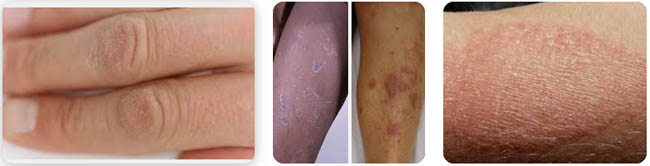
Atopic dermatitis has very diverse clinical manifestations. Depending on the stage of the lesion, the disease has different typical symptoms.
Acute phase: On the skin, there appears a circular red rash, with a peeling surface and blisters, inflammatory fluid secretion, and swelling around it. These rashes cause itching and a burning sensation, causing people with atopic dermatitis to scratch a lot, especially at night.
Chronic stage: Red papules on the skin become keratinized, scaly, and have pigmentation disorders. When the patient scratches a lot, it can cause the damaged skin to become more severe, with peeling, thickening, cracking, and yellow scaly fluid. Lesions often appear in the folds of the limbs, especially the hands.
3. Psoriasis
Another disease that often recurs in the dry season is psoriasis with red patches of different sizes. However, psoriasis is benign, treatment is simple by “cleaning” the lesions quickly and prolonging the recurrence time. The typical lesions of psoriasis are red skin surface, white scales, easy to peel and often appear on the scalp, knees, elbows, sacrum, they often appear when the weather is dry and cold. In particular, this is a chronic skin disease, hereditary.
4. Eczema
Seborrheic eczema causes the patient’s skin to become tight, dry, with many horizontal and vertical cracks, thin white scales, peeling at the edges, and itchy and burning. When experiencing these symptoms, the patient should not bathe in water that is too hot, scrub, or scratch vigorously. It is necessary to see a dermatologist to get antibiotics, topical medications to soften the skin, and keep the skin moisturized, and drink plenty of water during the day.
5. Hives
This is a disease that can be caused by endogenous or exogenous factors. If in the cold season, you have raised, itchy, pink or red patches on your body or face. That is exogenous urticaria, or otherwise known as cold‐temperature rash. On the other hand, it is necessary to distinguish between skin pathology problems and dry skin caused by the dry season. Dry skin is a skin type, not related to pre‐existing diseases. It is classified as a skin type. But in the dry season, normal dry skin that is not regularly moisturized is still at risk of skin pathology problems.
II. HOW TO TAKE CARE OF YOUR SKIN IN THE DRY SEASON
We can’t control the weather, but we can change our daily routines. With the current drastic climate change, we still need to have the right methods and ways to care for dry skin:

Skin care in the dry season is very important, regardless of the elderly or children, regardless of gender. A reasonable diet helps the skin fight against dryness, in addition to a reasonable amount of calories, it also ensures enough vitamins. Foods containing lots of vitamins and water are recommended;
Reasonable diet, eat a little lean meat every day, avoid eating foods with too much fatty acids. Add foods rich in vitamin A to your daily diet (carrots, beef liver, eggs, fish oil.). Eat foods rich in iron, to help replenish blood for the skin;
To prevent dry skin, it is necessary to provide enough water for the skin by drinking water regularly. The minimum amount of water to drink in a day is 2 liters/day. To ensure the amount of water for the body as well as the skin in the dry season, it is necessary to drink a lot of filtered water and fresh fruit juice to purify the kidneys and provide enough vitamins for the skin, especially vitamin C;
You should eat a lot of green vegetables and supplement with vitamin C (oranges, lemons, tangerines, watermelons, tomatoes). Vitamin C is extremely important for healing skin cracks and small blood vessels;
Avoid spicy foods such as coffee, chili, pepper, fried and grilled foods;
Every day, you need to bathe but should not bathe for too long, usually only 5 ‐ 10 minutes each time is enough. If you bathe for too long, your skin will become dehydrated and dry. You should bathe with warm water, not hot water because hot water removes the skin’s natural oils, making the skin dry and cracked. You should use neutral soap because alkaline soap will cause the skin to lose its protective lipid layer, causing the skin to become dehydrated and dry. When bathing, you should close the bathroom door to keep the air in the room humid enough. After bathing, you should wipe your body with a soft cloth, then apply moisturizer within 3 minutes after bathing. Do not let the skin dry for too long before applying moisturizer;
Limit washing your face with hot water: Warm water will help dilate pores, thereby creating space for the skin to breathe and be more elastic after a stressful day at work. However, you should not use water that is too hot to wash your face. Because the high temperature of the water will damage the skin’s structure, thereby causing the skin to dry quickly and possibly cause rashes and redness;
Many people often wash their face with hot water to feel more comfortable in dry weather. However, hot water often dries out the skin, making it more prone to cracking. Therefore, you should wash your face with cool water. Do not use cleansers that have strong oil‐removing properties.
For dry skin, you should regularly use moisturizer. If your skin is still dry or feels itchy, burning, or uncomfortable, you can increase the number of times you apply the cream during the day. Regular use of moisturizer also helps prevent skin from peeling and cracking;
You should choose a moisturizer that is suitable for your skin, and pay attention to the ingredients of the cream;
Protect your skin carefully when going out: Dry weather makes your skin dry faster, and if exposed to a lot of dust and smoke, your skin will be more prone to cracking and inflammation. Therefore, make sure you protect and cover your skin carefully when going out. The sunlight in the dry season is usually not too harsh but can make your skin condition worse and lose its color. Therefore, do not forget to apply sunscreen 30 minutes before going out;
Exfoliate regularly: One of the ways to keep your skin soft, rosy, and free of peeling and cracking during the dry season is to exfoliate your skin twice a week. This will help you remove dirt, improve blood circulation, and keep your skin healthy and beautiful;
Spray mineral water regularly: Water on the skin’s surface evaporates easily in cold climates, which is why our skin dries faster in this season. Therefore, you should regularly spray mineral water to provide timely water, helping to limit dry, chapped skin.
Apply moisturizer every night: This is a must every night. Before going to bed, remember to apply moisturizer to your skin, so that you can fully complete the steps of moisturizing your skin. However, make sure you have removed your makeup and washed your face thoroughly before applying the cream, otherwise it will have the opposite effect;
Should use creams containing ceramide, hyaluronic acid, glycerin while the skin is still moist. Ceramide is a natural component in the stratum corneum, the outermost layer of the skin, playing a major role in maintaining healthy skin and protecting the skin against aging, protecting the components under the skin. Some creams contain lipid components similar to the lipid structure on the skin, which has the effect of strengthening the connection between epidermal cells, preventing dry skin.
Apply moisturizing masks for dry skin: Using masks to add moisture to the skin on dry days is extremely necessary. You should use masks that provide the best moisture to the skin such as potato masks, honey butter masks, fresh milk honey masks, aloe vera masks.
To prevent diseases in the dry season, people should pay attention to wearing comfortable clothes, not too hot, not too cold, eat lots of green vegetables and fresh fruits. If possible, depending on physiological needs, it is best to eat fresh fruits or green vegetables every day. When going out, you should wear a mask, glasses, and a hat to limit dust and wind, which will cause skin diseases to recur and become more severe;
Patients with atopic dermatitis need to cooperate closely with their doctor in treatment, and should not stop using the drug on their own when there are signs of improvement. Treatment regimen for atopic dermatitis : Use moisturizer to prevent dry skin; Use topical corticosteroids for a short time, then maintain tacrolimus and moisturizer for a long time to limit recurrence of atopic dermatitis; Use topical or oral antibiotics to prevent staphylococcal infections; Use antihistamines to prevent itching;
Care for atopic dermatitis: Avoid scratching or rubbing the affected skin area, apply moisturizer daily to prevent dry skin, reduce itching, and limit contact with allergens.

III. MISTAKES IN SKIN CARE IN DRY SEASON THAT NEED TO BE CORRECTED
When the skin condition worsens, many people often lose their composure and look for quick skin recovery methods to instantly improve dry skin conditions such as mixed creams, herbal baths, traditional medicine, folk medicine, etc.;
However, doctors do not recommend the above methods because they have not been verified by research tests or scientific documents. Sometimes leaves and folk remedies have moisturizing ingredients, but still contain impurities. For example, aloe vera leaves have moisturizing properties, but aloe vera sap when applied directly to the skin can cause allergies, causing red skin;
Do not drink water In the cold and dry season, the body often does not feel thirsty like in the summer, leading to forgetting to drink water. The role of adding water to the body to promote metabolism, purify toxins, and maintain life is most correct;
According to the advice of dermatologists and skin care experts: Apply moisturizer or oil, depending on each skin type and the condition of peeling or redness, you should choose the right texture and moisturizing ingredients for yourself. For dry skin, use cream moisturizers with a soft, thin, smooth texture. For sensitive skin, milky or gel textures help both moisturize and soothe the skin;
Stay away from hot water: Everyone has the idea of bathing every day to clean the skin. However, in the dry season or even the cold season, it is necessary to avoid using hot water. Although bathing in hot water will help relax the mind, it will cause the skin to lose its moisture balance and beneficial microflora, leading to the inherent moisture under the skin being lost through the skin surface. Therefore, instead of using hot water, you should mix warm water with an ideal temperature range so as not to affect the activity of the sebum glands of the pores;
After bathing, apply moisturizer immediately. Ointments and creams are more effective on dry skin. Read the ingredients on skin care products; deodorant soaps, alcohol‐based toners, and products containing fragrance can irritate dry, sensitive skin;
Don’t skip hand washing, which can remove harmful bacteria and viruses. If you need to wash your hands frequently, hand sanitizer is a good choice. After each hand washing, apply moisturizer immediately. If your hands are frequently submerged in water, wear waterproof gloves for protection.
Author: Dr. Huynh Hong Quang
(Quy Nhon Institute of Malaria, Parasitology and Immunology)


