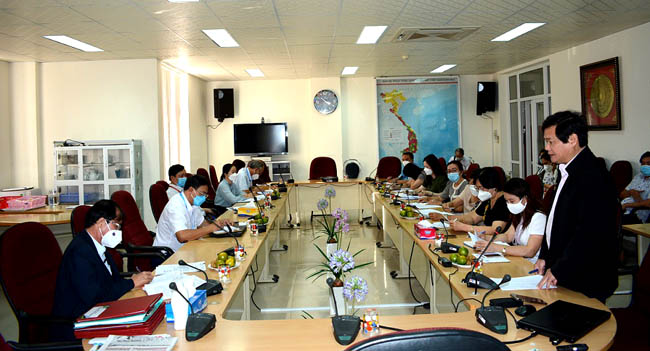
The Institute of Malariology, Parasitology and Entomology Quy Nhon (IMPE‐QN) has hosted a delegation from Binh Dinh Provincial Union of Science and Technology Associations (PUSTA) and Binh Dinh Provincial Department of Science and Technology (PDST) on 09th March 2022. The visit was an initial step in the forthcoming plan for research cooperation in accordance with the provincial policy on promotion of science and technology proliferation in the period of 2020‐2025.

The Institute of Malariology, Parasitology and Entomology Quy Nhon (IMPE‐QN) has hosted a delegation from Binh Dinh Provincial Union of Science and Technology Associations (PUSTA) and Binh Dinh Provincial Department of Science and Technology (PDST) on 09th March 2022. The visit was an initial step in the forthcoming plan for research cooperation in accordance with the provincial policy on promotion of science and technology proliferation in the period of 2020‐2025.
The meeting was attended by IMPE‐QN delegates including Assoc. Prof. Ho Van Hoang ‐ Director, Dr. Huynh Hong Quang ‐ Vice Director, and staff members of the Institute’s Council for Science and Technology. The counterparts were Dr. Nguyen Thi Thanh Binh ‐ Chairwoman of PUSTA, Dr. Le Cong Nhuong ‐ Director of PDST, and other experts.
IMPE‐QN is a public service unit directly under the Ministry of Health, with the function of providing non‐business services in controlling malaria, other parasitic and vector‐borne diseases as well as related tropical diseases; conducting scientific research, providing training and retraining for medical manpower, providing professional and technical direction for lower levels in the prevention and control of malaria, other parasitic and vector‐borne and related tropical diseases within 15 provinces of Central Coast and West Highlands. The institute’s headquarter is based in Quy Nhon city, Binh Dinh province with the total staff members of 216 (103 males accounting for 48%; 113 females accounting for 52%).
For the purpose of developing IMPE‐QN into a leading institution in the field of controlling malaria, parasitosis, vector‐borne and tropical diseases; and satisfying the demand for scientific research, providing preventive health and treatment service at the same level as the national institutions, the IMPE‐QN has defined the specific objectives as follows:
- To design a plan for malaria control and elimination in accordance with the Decision 1920/QD‐TTg by the Prime Minister and the Decision 08/QD‐BYT by the Minister of Health;
- To enhance the capacity in studying and controlling emerging helminthiasis, mycoses, protozoan infections, and other tropical diseases; moving steadily towards control and elimination of some helminthiases;
- To enhance the study, surveillance, and guidance capacity on dengue vector and insect control;
- To transform the Institute to meet the demand for health care, epidemic control, especially serious epidemics such as COVID‐19, parasitosis, tropical diseases in the new period of time.
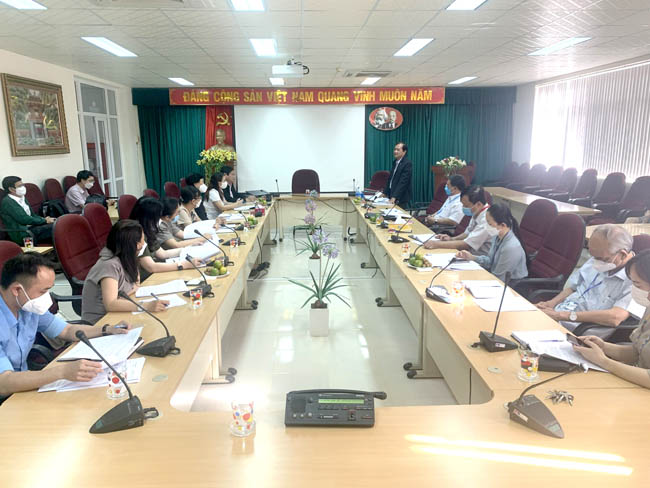
At the meeting, Assoc. Prof. Ho Van Hoang has appreciated and valued the cooperation between IMPE‐QN and PDST in scientific research in the upcoming time. Assoc. Prof. Ho Van Hoang really hoped that both units could utilize the two sides’ strengths in transferring technology, enhancing the staff ability and skills in scientific research, and training the youth to learn and inherit the precious knowledge from the leading experts. According to Assoc. Prof. Ho Van Hoang, during the COVID‐19 pandemic, the IMPE‐QN was among the institutions (along with Pasteur Institute in Nha Trang and Hue Central Hospital) that have been assigned a critical task by the Ministry of Health (MoH) in Central Vietnam. The task was to prepare human resources, biological products, Realtime‐PCR instruments for the diagnostic testing of SARS‐CoV‐2. At present, the Molecular Biology Laboratory Department could process a maximum of 400 samples per day and report the results after 5 hours. Since 2020, the IMPE‐QN has carried out RT‐PCR testing in Binh Dinh, Phu Yen, Quang Nam provinces, and some other neighboring provinces. In addition, the IMPE‐QN has also sent medical staff to the hot‐spot provinces to support the sample collection. The IMPE‐QN also sent delegates a MoH delegation to investigate, monitor the Covid‐19 pandemic control in some central coastal and western highlands provinces.
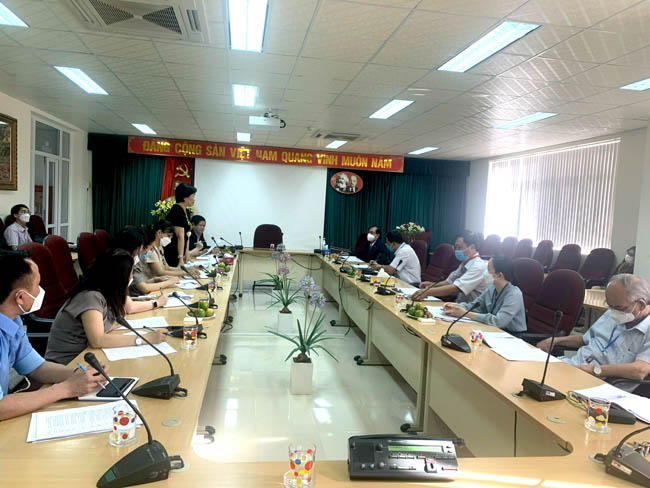
At the meeting, Dr. Nguyen Thi Thanh Binh also shared her thought on the strength of IMPE‐QN including carrying out in‐depth research on malaria and helminthiasis, especially fascioliasis; providing competent experts that could conduct professional consulting and peer review; providing training, coordinated training, and re‐training thanks to the institute’s educational facility and leading lecturers; transferring the technology and science, modern facilities/equipment/instruments and professional staff. Besides, Dr. Nguyen Thi Thanh Binh also recommended the two units should draw up a Memorandum of Understanding on the cooperation between IMPE‐QN, PDST, and the Binh Dinh Provincial People’s Committee.