Globally, the number of countries with endemic malaria in 2000 and reporting fewer than 10,000 cases of malaria increased by 70%, from 27 in 2000 to 46 in 2022. During the same period, the number of countries reporting fewer than 100 indigenous cases increased from 6 to 27.

Part 1: Major malaria events in 2022‐2023
Part 2: Estimated malaria cases and deaths, 2000‐2022
Part 3: Estimated malaria cases and deaths in malaria hotspot areas by WHO region
PART 4: MALARIA ELIMINATION
+ Update on malaria elimination progress
Malaria elimination has gathered momentum in many countries as they move closer to achieving zero indigenous malaria cases. In 2022, a total of 85 countries (including French Guiana) had endemic malaria, compared to 84 countries in 2021. Globally, the number of countries that had endemic malaria in 2000 and reported fewer than 10,000 cases increased by 70%, from 27 in 2000 to 46 in 2022. Over the same period, the number of countries reporting fewer than 100 indigenous cases increased from 6 to 27. However, when comparing 2021 and 2022, there is a slight decrease from 28 to 27 countries due to an increase in the number of indigenous cases reported by the Islamic Republic of Iran, which reported more than 1,000 cases in 2022. From 2000 to 2022, countries reporting fewer than 10 indigenous cases increased from 4 to 25 countries, but the number of countries remained unchanged when comparing 2021 and 2022.

Source: World malaria report, 2023
Between 2000 and 2023, 25 countries that were malaria‐endemic in 2000 achieved three consecutive years of zero indigenous malaria cases; 15 of these countries were certified malaria‐free by WHO. Malaria elimination certification requires the elimination of four major human parasite species: P. falciparum , P. vivax , P. ovale , and P. malariae . A country or area is certified malaria‐free when it has demonstrated that the chain of mosquito‐borne transmission has been interrupted nationwide, resulting in no indigenous malaria cases for at least three consecutive years. In addition, a program must be in place to prevent the reintroduction of malaria. No country will be certified malaria‐free by 2022, but three countries, including Azerbaijan, Belize, and Tajikistan, will be certified by 2023.
Note: Green: Eligible country and certified malaria elimination.
Blue: Eligible country but not yet certified malaria elimination.
Source: World malaria report, 2023
+ E‐2025 Initiative
The E‐2025 Countries Initiative was launched in 2021 and is a continuation of the E‐2020 initiative. E‐2025 includes 25 countries and one region: Belize, Bhutan, Botswana, Cabo Verde, Comoros, Costa Rica, Democratic People’s Republic of Korea, Dominican Republic, Ecuador, Eswatini, French Guiana, Guatemala, Honduras, Islamic Republic of Iran, Malaysia, Mexico, Nepal, Panama, Republic of Korea, Sao Tome and Principe, Saudi Arabia, South Africa, Suriname, Thailand, Timor‐Leste and Vanuatu. The selection of E‐2025 countries was based on criteria such as having a government‐approved elimination plan, meeting a defined malaria case reduction threshold in recent years, meeting pre‐defined programmatic requirements and expert opinion (including WHO).
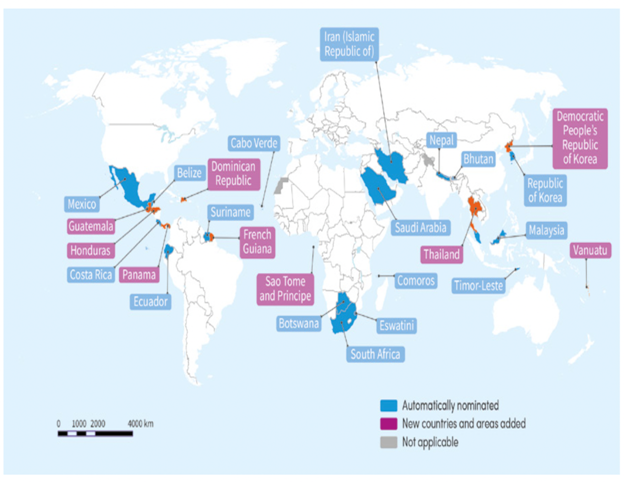
Between 2010 and 2022, indigenous malaria cases decreased by 72.3% across E‐2025 countries and areas, with increases observed in 2017‐2018 and then again in 2021. In 2022, E‐2025 countries and areas reported 53,407 indigenous cases, marking an overall increase of 61.8% from 33,001 cases in 2021. This increase was largely due to an alarming increase in cases in Comoros, which almost doubled its cases from 10,537 in 2021 to 20,675 in 2022. Other countries also saw significant increases during this period: Costa Rica more than doubled its cases, from 189 in 2021 to 20,675 in 2022. 2021 to 409 in 2022; Panama saw an increase from 4,354 in 2021 to 7,102 in 2022; Thailand reported a significant increase, from 2,426 in 2021 to 6,263 in 2022; Honduras more than doubled its number of cases, from 1,542 in 2021 to 3,534 in 2022; and Vanuatu saw a nearly fourfold increase, from 312 in 2021 to 1,102 in 2022. Other countries reporting varying degrees of increase in cases during the same period were the Dominican Republic (12.6%), Guatemala (45.7%), Nepal (12.5%), South Korea (39.4%), and Sao Tome and Principe (46.0%).
For the second consecutive year, Nepal continues to report clinical cases. The country continues to treat patients based on clinical symptoms alone, according to national guidelines, even when diagnostic tests are negative. This approach remains a concern; revisions to the country’s case management guidelines could address the issue but have not yet been implemented. In addition, the resurgence of indigenous cases in the Islamic Republic of Iran is a concern, with 1,439 indigenous cases reported in 2022 after four consecutive years of no indigenous cases.
Despite the setbacks, several countries and one region have recorded notable reductions in domestic transmission: Botswana (43.5%), Democratic People’s Republic of Korea (9.3%), Ecuador (38.0%), Eswatini (57.6%), French Guiana (71.6%), Mexico (32.6%), and South Africa (31.3%). Additionally, Belize was recently certified malaria‐free, and Cabo Verde reported zero cases of malaria for the fourth consecutive year. Malaysia reported zero domestic cases of Plasmodium infection in humans for the fifth consecutive year. After an outbreak of three cases in Timor‐Leste in 2020, the country has managed to regroup its efforts, achieving two consecutive years of zero domestic cases in 2021 and 2022 (in fact, for 36 consecutive months by 2023). Saudi Arabia also achieved two consecutive years of zero indigenous cases in 2021 and 2022; Additionally, for the first time, both Bhutan and Suriname reported zero indigenous cases in their efforts to achieve the malaria elimination certification milestone.
Table 2. Estimated number of domestic THBSR in countries and regions under the E‐2025 initiative, 2010‐2022

+ P. knowlesi disease burden and transmission
In recent years, P. knowlesi has emerged as a significant concern in malaria cases, particularly in countries of the WHO Southeast Asia Region such as Indonesia, Malaysia, and Thailand. In 2022, a total of 2,768 P. knowlesi cases were reported globally, down 24.2% from 2021 (3,651 cases). The number of indigenous P. knowlesi cases also decreased by 26%, from 3,629 cases in 2021 to 2,682 cases in 2022. Malaysia continues to be the dominant source of P. knowlesi infections , followed by Thailand and Indonesia, contributing 90.5%, 3.1%, and 0.1%, respectively, in 2022. In 2022, all indigenous malaria deaths in Malaysia and Thailand were due to P. knowlesi .
In Malaysia, there was a 30% reduction in the total number of P. knowlesi cases , from 3,575 in 2021 to 2,505 in 2022. Most (99.9%) of P. knowlesi cases detected in 2022 were classified as indigenous. The total number of P. knowlesi cases increased from 5 cases reported in 2021 to 87 cases in 2022 in Indonesia and 71 cases in 2021 to 176 cases in 2022 in Thailand. Although Malaysia reported the highest number of P. knowlesi cases , the rate of increase was strongest in Indonesia and Thailand in 2022.
The increasing burden and transmission of P. knowlesi poses particular challenges for malaria elimination; it also has implications for certification of malaria elimination. To date, certification has been granted to countries where only four human Plasmodium species are transmitted. With P. knowlesi transmission on the rise, WHO convened its advisory groups to discuss the implications of P. knowlesi for certification of malaria elimination. If a country can eliminate transmission of the four main human malaria parasites but is still transmitting other species, certification may be granted if the risk of transmission is assessed as negligible.
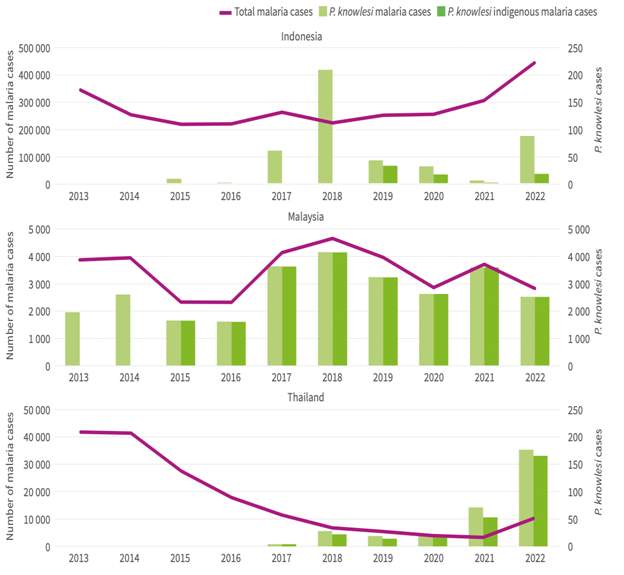
Source: World malaria report, 2023
References: WHO (2023) World malaria report 2023
uthor: Dr. Nguyen Cong Trung Dung, Associate Professor, Dr. Ho Van Hoang